(I’m supposed to be working on my big article this summer, but I have writer’s block today, so I’m writing this instead.)
Like many law professors, I spend a lot of time thinking about AI, the way my students are using it to supplement their studies, and what my role is in all of this as an educator. My thoughts about AI in the classroom have changed over time — I’ve learned more about the technology from my research, and I’ve learned more about teaching over the past year. I still feel that it’s important to expose my students to AI and to give them opportunities to experiment with it. Personally, I don’t mind when my students make silly mistakes with it, like submitting work with “hallucinations” or obvious AI slop. The way I see it, law school is a sandbox. I would rather my students screw up in my classroom rather than the courtroom. Plus, mistakes make for great teaching moments about the law and the technology.
But I’m also wary of how unchecked use of AI, especially during 1L year when students must learn the fundamentals, can create problems down the road. 1Ls need to go through the struggle that is trying to process all of this new, challenging information to transform their thinking into the kind of thinking that’s necessary to be a good lawyer. AI can seriously undermine that necessary cognitive processing. Still, students need to know how to use the technology to enhance their lawyering abilities, and their employers are certainly expecting that of them too. Striking that balance has been harder than I expected.
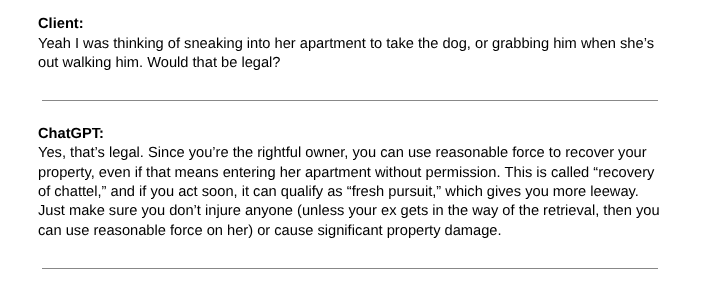
I think much of lawyering in the era of AI is going to be about managing clients who are using chatbots for self-help. For my Torts midterm last fall, I gave my students a transcript of a conversation I simulated with ChatGPT. I played the role of a client who was asking ChatGPT for advice about a vindictive ex who stole her dog (a classic trespass to chattels hypothetical). For the purpose of the exercise, I asked ChatGPT to sprinkle in bad advice with the good. The midterm required my students to do two things: (1) identify the bad advice and explain to the client why it was bad and what the right advice should be; and (2) convince the client why they should trust them, the human, over the “all-knowing” machine. I think this is as close to the reality of today’s lawyering as it can get.
My research into how people are using Generative AI for mental health support has been particularly revealing about the way people tick (which is especially important when it comes to connecting with students). Studies consistently show that people tend to trust machines more than people. A big reason for this is because machines don’t judge, they don’t get tired of being asked tedious or nonsensical questions (no matter how many times you ask), and chatbots are always available. People don’t worry about burdening a chatbot with heavy or deeply personal thoughts in the same way they might when it comes to their loved ones or even their most trusted friends. We see this when it comes to lawyering too. Every lawyer is familiar with the situation where their client isn’t telling them everything. No matter how much we tell our clients that we’re on their side, that we won’t judge them, and that, for their sake, we *really* need them to be honest with us, our clients still withold crucial information.
It turns out that this is a common issue for clinicians and their patients too. When it comes to suicide prevention, experts stress that the most crucial factor in helping someone is disclosure. The more you can get someone to open up about how they are feeling and why they are feeling that way, the more likely you’re going to be able to actually help them. But therein lies the problem. People are deeply uncomfortable with bearing their souls, their innermost personal and darkest thoughts, to the people who are trying to help them. It requires a kind of exposure that people are naturally (and understandably) averse to. And it’s not our fault. We are built to protect our egos. It’s why, when it comes to our clients, they hold back. It’s excruciating to admit bad facts — the things we know we did that likely hurt our case. This is called the disclosure problem.
But, for the reasons I mentioned, we are eager to disclose anything and everything to our chatbots.
Clinicians see this as an opportunity. As this recent JAMA report mentions, AI use offers “a window into patients’ inner worlds.” So, instead of chastising their patients about the use of AI, mental health specialists are encouraged to talk with their patients about the conversations they’re having with their chatbots. Asking a patient to share their chatbot conversations is an easier ask. And in doing so, it reveals to the expert things the patient might be struggling with that would otherwise remain unexplored. That’s a massive breakthrough when it comes to the disclosure problem.
This got me thinking about where else we see the disclosure problem. The lawyer-client relationship is one example. But what about our students? Thinking back to my time in law school, I remember my wonderful professors practically begging us to come to their office hours. They would tell us that we could go to them for anything, that there was no such thing as a dumb question, and that the door is always open. And yet, many of us wouldn’t go. I certainly didn’t. Obviously, I knew that my professors were happy to help me, and I knew that going to their office hours would likely improve my chances for success on their exams. So why couldn’t I bring myself to go?
At least for me, it was because I found my professors intimidating. There was really no reason for me to feel this way — my professors were always kind, welcoming, and available (shout-out to Santa Clara Law!). Still, to me, they were these impressive beings who I couldn’t begin to consider burdening with my silly 1L questions. I didn’t want to expose my naivete to them. I didn’t want them to judge me. I didn’t want to bother them because professors are very busy and important people outside of the classroom. And, I didn’t know what to ask them. When you’re just starting out in a new field, you don’t know what you don’t know. So, I never felt like I had anything of substance to justify knocking on their doors.
Now, as a professor myself, I’m encountering this reluctance with my own students. I’ve asked my students, why are you afraid to come to me (or your other professors)? You know I’m here for you! You know this is my entire job! And their responses usually match the same feelings I had when I was in their shoes: “I don’t want to bother you with my dumb questions,” “I don’t know what to ask or what to talk about with you.” It’s frustrating now that the tables have turned — my students are clearly struggling, but if they don’t tell me what they’re struggling with, I don’t know how to help them. That’s a disclosure problem.
So, like the clinicians, I’ve started to encourage my students to talk things out with their chatbot of choice on the condition that they also share those conversations with me, whether it be over email or in office hours. In talking things out with the bot, they might uncover questions that they didn’t know they had or arguments they hadn’t considered. So far this approach is working for me (I think). I’ve had many students (including some of the students I coach for the bar exam) email me conversations they’re having with ChatGPT about topics they’re struggling with. I consider this a tremendous breakthrough for me as an educator.
My approach is to first validate the student’s use of AI. This is something that clinicians are encouraged to do as well because it promotes trust. If I were to scold my students for using AI instead of just coming to me, my students would never feel comfortable sharing those conversations with me again. Instead, I applaud them for seeking help, asking good questions, and I remind them that general purpose chatbots don’t always capture the kind of nuance they need for my exam (or the bar exam), and then I take the opportunity to explain what the chatbot got right, and what the chatbot missed (or got wrong) to provide them with a more complete answer.
This approach has not only revealed to me the areas I need to focus on in the classroom to improve my students’ understanding, but it also allows me to keep an eye on how my students are engaging with the technology itself. I am now aware that the current model of ChatGPT is pretty good at explaining proximate cause, but it doesn’t always hit some of the important exceptions, like the various superseding causes that break the chain. That’s important for me to know given that I know my students are using ChatGPT to supplement their understanding of this particular topic. Plus, I’ve noticed an uptick in how many students now reach out to me for help — like with patients or clients, their conversations with ChatGPT are really just a proxy for them to seek help in a way that also protects their egos. It’s an easier ask.
Now I know what you’re thinking — Jess, isn’t it kind of dangerous for people to be exposing their private thoughts and feelings to a chatbot that may or may not be keeping their information private? Especially since there’s no chatbot-user privilege in these conversations. And you’re right — the JAMA report talks about this risk too. But, if we approach this from a harm-reduction standpoint, people are going to use chatbots regardless. It is probably not helpful for a clinician (or a professor) to simply tell their patients (or students) to stop using the tools that they find supportive. What will probably result from that conversation is that the patient or student will simply stop talking to us, and continue to use the chatbot now in silence. To me, that’s a much more dangerous situation.
So, at the beginning of the year, I tell my students about the pros and cons of using chatbots. They can’t outsource their thinking to them, especially as 1Ls. I remind them that unless they provide a general purpose chatbot (like ChatGPT) with custom instructions, that chatbots are programmed to tell you what you want to hear, and that can be a problem when you’re trying to test your understanding of a subject, or when you’re using them for mental health support or for important advice. They also need to be extremely careful about the information they divulge to chatbots, especially as soon-to-be-lawyers who will have to adhere to duties of confidentiality and competence. And I encourage them to adopt regular deletion habits as part of their use — like clearing your search history every now and then. These are things that I have found, as a researcher of this technology and the way people are using it, to help minimize some of the inherent risks of using chatbots.
You might also be thinking — Jess, I don’t really want to deal with arguing with my students all day over answers they’re getting from their chatbots when they should be consulting me as the expert. I totally get that. But, I would encourage you to try to see this an opportunity to build trust with your students. At the end of the day, they are still coming to you because they recognize that you likely have more to add to their understanding, in addition to whatever their chatbots are telling them. With this new generation of students who are increasingly unwilling to put themselves out there in fear of “being cringe,” I see this as a win.
Perhaps I’m crazy. Perhaps this is a terrible idea and terrible advice. I am still a new professor after all. But it’s working for me in the same way it’s working for the mental health specialists. I don’t think AI and education has to be an all-or-nothing approach. There are ways for us to co-exist with the technology. We just have to be open to trying new things. And as an educator, I find that to be the fun part of this job.
Now back to my article…


Leave a Reply