To the student who told me to get back into blogging, this one’s for you.
When I landed my dream job in academia, I thought I would finally feel complete. Every career move I made in my 20’s, every thinkpiece, blog, tweet, speaking gig, was all in the pursuit of becoming an academic. Academics have the freedom to speak their minds. And I’ve always had a lot to say, which, until now, usually got me in trouble.
But since becoming an academic, I feel more like the dog who caught the car. I have a lot to say, and all the freedom now to say it, but suddenly I don’t know how. In the year and a half I’ve been in the academy, I’ve gone from prolific to paltry. Suddenly, the things I feel like I have to say don’t feel important enough to be said. I haven’t done enough research. I don’t have enough nuance. I don’t have the credentials. I’m hesitant and cautious. What is academic freedom without a voice to use it?
Perhaps this is a good thing. It’s growth. I’m not as smart as I thought I was. I don’t have it all figured out. There’s always another angle. I’m becoming a more “careful thinker” as some might say. Still, academia seems to be the one career where the more you learn, and the more experience you gain, the less you feel like you know and the less confident you become. Which can be paralyzing.
Academics also speak an entirely different language. They speak in code, methodologies, theories (whatever the word “praxis” means). I don’t. Much of my academic voice feels borrowed from the academics I’ve studied.
These vulnerabilities probably stem from how I managed to break into the academy. I won’t discount my intelligence or passion. I’m smart. I’m driven. I’m outspoken. I throw my all into the issues I care about. And I recognize that is certainly an important part of my sales pitch.
But I also skipped so many steps getting here.
I wrote a lot in law school, but I wasn’t on law review, so I missed many of the requisite skills for academic legal writing. I don’t have a PhD (like many of my brilliant colleagues), so I wasn’t forged in the fire of “proper” research training. I didn’t practice that long, so I don’t feel like I have the right to teach anyone anything. I didn’t go through the “meat market,” so I haven’t even suffered like a “real” academic. If The Academy is a city, I move through it as a tourist.
I thought ChatGPT might help. So, I tried that for a while. I figured, I’ll use the tools that make me sound like I belong, and I’ll find my academic voice when I have tenure. It’s funny how that works by the way. The pursuit of tenure quickly became a crutch, no different from “I’ll get to it later.” But there’s no end to later; there’s just more later.
I stopped blogging. I felt I didn’t have the luxury to spare cycles on things that are not what I’m supposed to be writing (like my first article). But then the self-imposed academic freeze wasn’t getting me anywhere either, and between not blogging, and not writing my article, suddenly, I’m just not writing at all.
Like the future promise of tenure, ChatGPT too became a crutch. It turns out, discovering and honing your voice is a necessary part of the academic learning curve that I was trying to shortcut. And even now as I write this piece, I’m fighting the urge to copy and paste it into the sound-good machines that replace any trace of the identity I’m, for some reason, desperate to mask. (To my students: do as I say, not as I do).
Towards the end of yet another “unproductive” semester, I started to think maybe I stumbled into the wrong career. Maybe I finally met my match, and I just can’t cut it. That doesn’t mean I’m a failure or that I’m unworthy of ever experiencing success, it’s just that maybe this is not for me. Maybe all this time I was simply in love with the idea of being an academic. Because if I really wanted it, I’d be published by now. Some professors were churning out articles long before becoming academics all while meeting their billables (or so I’ve been told). I had three classes to manage. Surely, I just don’t want it badly enough.
It’s a scary thought for someone who moved through her 20’s so sure of what she wanted to get out of this life.
I decided the AALS conference would be the litmus test for whether I would continue to stick this whole academic thing out. A few of my academic friends tried to talk me out of going. The consensus seemed to be that AALS is a waste of time. And maybe it is for the academics who do have it all figured out. My story is different.
I figured if my AALS experience left me feeling like a complete and utter outsider, that would be my sign to hang it up. I went with the mindset that I wasn’t going to fit in, which is strange, because this wasn’t my first academic conference. And in fact, I was able to hold my own at much higher-stakes conferences as a first year law student engaging with some of the most highly regarded professors in my field. Though, that might speak more to the bliss of a softer frontal lobe.
My first day didn’t start out great. There are definitely cliques in academia. It’s like high school, though this time the popular kids are the nerdiest of the nerds. Placement and rank are the street cred here; like the designer clothes and makeup of the girls I once envied, I had neither. But that’s okay—I never actually needed them.
Things got better. A professor friend connected me with his professor friend, and we shared an Uber to the conference hotel with a group of other professors who turned out to be welcoming and lovely. I met a dean who had recently become an expert in university plumbing systems, on a semester-long solo mission to restore even a semblance of normalcy to the law school’s bathrooms. (I don’t think I want to be a dean.)
I met a professor with the courage to dive head-first into starting a brand-new law school in Florida. Her passion for creating something different—and excellent—with a tiny faculty and limited resources was inspiring. I met a professor whose scholarship wields science fiction to explore contemporary constitutional dilemmas. (I didn’t know we could do that!) I met another professor who is writing a book of interviews with people who deliberately choose not to vote (many of their reasons were not at all what I expected). I traded tips with professors who were struggling with the same academic freeze I was currently facing.
I rekindled friendships with people I used to banter with on Twitter, who had just newly started their academic careers. I ran into scholars I had co-authored with during the pandemic but had never met in person. I went to the newbie happy hour, where I was greeted by new academics who were just as far along the learning curve as I was (read: not very far). We laughed about our insecurities, griped about the banality of legal institutions, and lovingly poked fun at our grumbly old-guard mentors who wouldn’t be caught dead at this conference.
I caught up with friends who had been cheering me on since law school. I shared laughs with my deans over happy hour. And I finally got to know one of my own colleagues, who happens to share an interest in some of the most esoteric scholarly curiosities (like death and Dawkins).
I stumbled into a two-hour conversation with a new professor from Indiana who taught me the magic of Zotero, and the simple joy of just writing the damn thing. I met a professor whose partner also lives across the country, and who lives a similar double life in fourteen-week spates. I bonded with women professors who feel the emotional load of managing student emotions—work our male counterparts often get to avoid. I met scholars who voraciously hated what I had to say, but could still appreciate that I was saying it. And I commiserated with fellow AI professors who just wish more people would take the time to understand the technology, rather than fear it.
I presented my current work-in-progress at a first-of-its-kind shark tank event—an article exploring the expressive architecture of generative models. The judges loved it. Their feedback gave me the breakthrough I needed to push past the freeze, and the confidence that maybe I actually did have something important to contribute. I also walked away with three more papers that were apparently stuffed in the one I had.
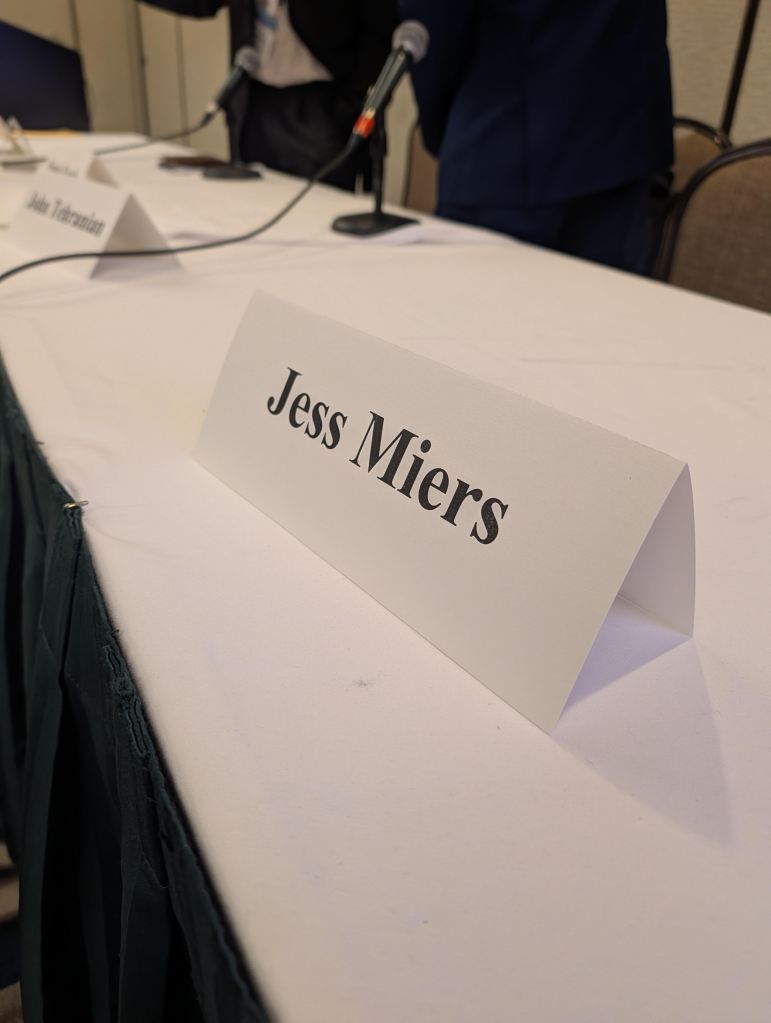
I spoke on a panel about Intellectual Property Theory & Praxis, where I felt wildly over my skis compared to my co-panelists, only to be thanked later by an audience member who told me I’d inspired them to teach about the technology in the cases they taught in their IP survey course. I attended a panel on Evidence pedagogy to support a colleague and walked away with an excellent recommendation for an open-source Torts casebook.
In the end, I didn’t need to act like I belonged, because I did. And with every shared laugh, curious question, “wow, I didn’t know that’s how that worked,” and “I’d be happy to review a draft,” I came to see that I was exactly where I needed to be on this journey. My brand of academic adds something the academy needs: a reminder that fancy credentials don’t always produce fancy ideas, and that what I lost by skipping certain steps I made up for in intellectual curiosity and a genuine willingness to engage collegiately—the very traits that got me here in the first place. That my voice is indeed my own, enhanced by, but not borrowed from, the scholars I emulate. And as with most of my career, success often looks nontraditional.
For me, AALS was worth it. And if you’re a new academic struggling with the insecurities that come with these roles, you might find it worth it too. Maybe I’ll see you at the next one. I know I’m here to stay.
One of my goals for this year is to reuinte with my voice and get back to writing. I’m going to use this space to blog about my academic journey. If that interests you, stick around. I have a lot to say, and I think I know how to say it now.
 Ctrl-Alt-Dissent
Leave a comment